
Logistics & warehousing · Ports
Quay and yard safety that never leaves the terminal.
Bring governed visual intelligence to quays, yards, and gates: heavy-equipment proximity, restricted berth zones, PPE, and container-flow analytics, while video stays inside your port estate.
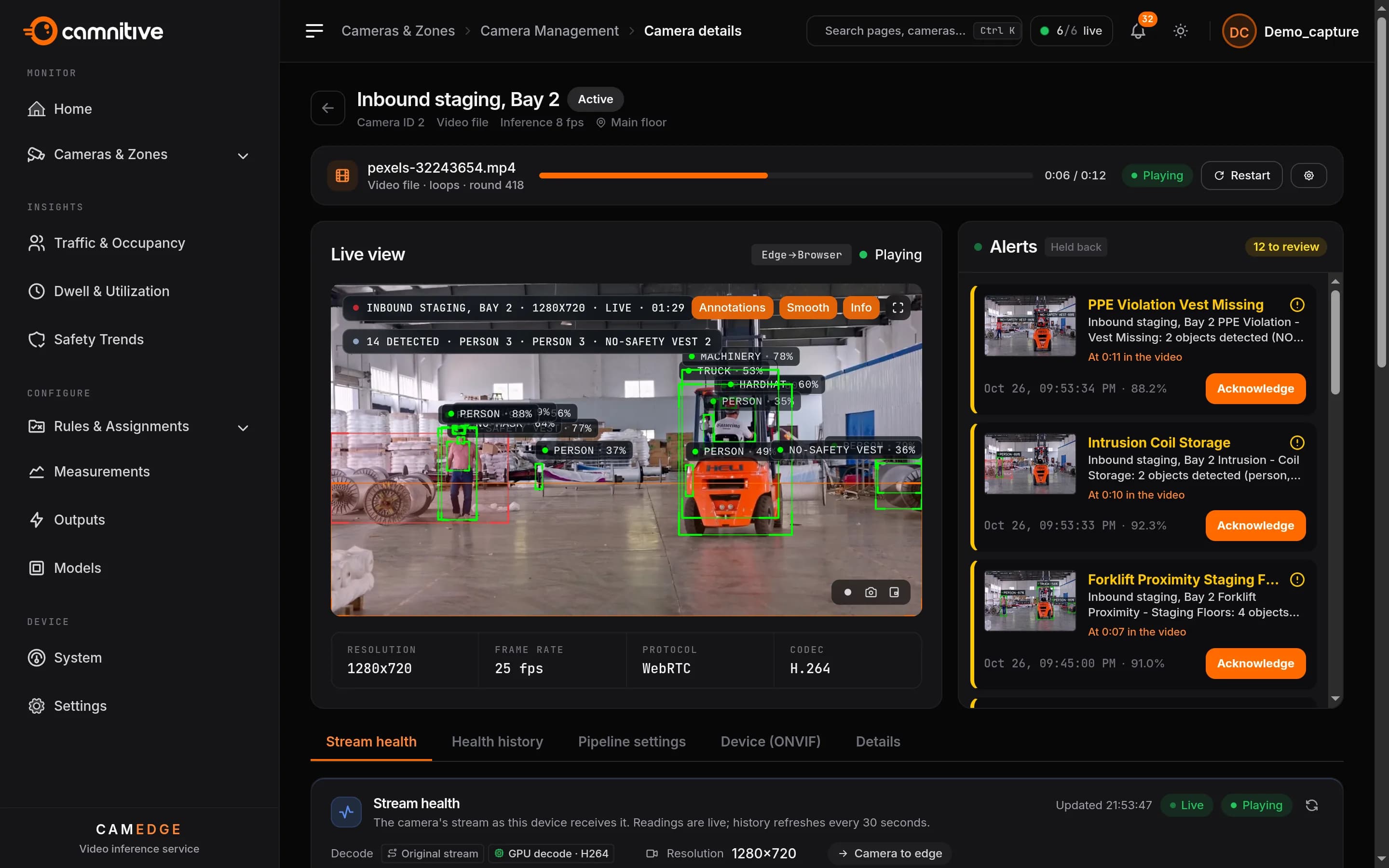
In ports
What goes wrong today.
Terminal equipment operates at lethal scale
Straddle carriers, reach stackers, and terminal tractors move faster than people can react. Proximity rules exist on paper.
ISPS obligations demand evidence on demand
Security incidents, restricted-area breaches, and access events must be documented. Manual clip hunts do not scale.
Gate congestion is measured by complaint
Truck queues and turn times are known only when carriers escalate. The data to fix flow was never collected.
Detect · Step 1 of 4
What the cameras watch for.
Reads a parallel stream from terminal CCTV without touching the certified ISPS recording chain.
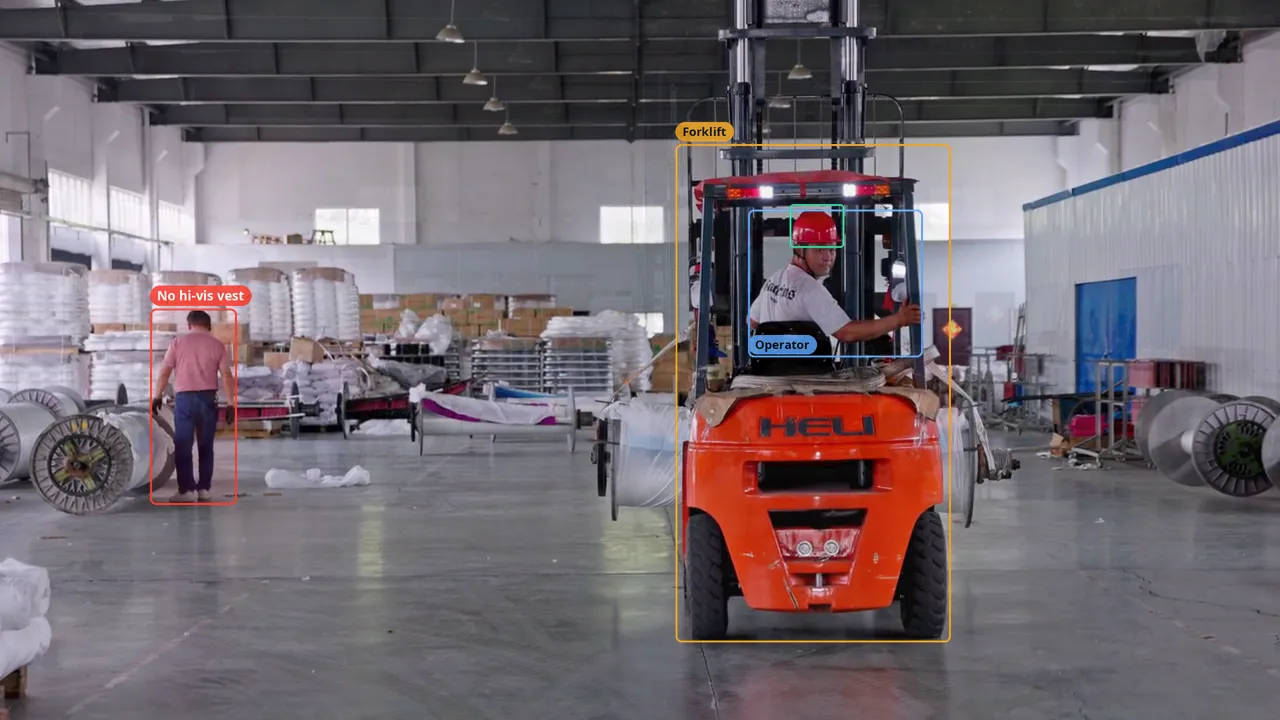
Sealed evidence
Halden Freight Park
Demo footage, annotated the way FloFrame does. Each card appears as its alert is raised.
Quay & yard proximity
Keep people clear of straddle carriers, reach stackers, and terminal tractors.
Restricted berth zones
Enforce exclusion areas around active cranes and mooring operations.
Gate & queue analytics
Truck queue, turn time, and gate-flow measurement from existing cameras.
PPE compliance
Vest and helmet verification across terminal work areas.
Container handling events
Dwell, staging, and abnormal handling flagged with sealed evidence.
Perimeter & ISPS security
Intrusion detection aligned with port security obligations.
Rules
Rules you would run.
Written in plain words, run on site, checked by a vision model before anyone is alerted.
Carrier proximity
“No person within 15 m of a moving straddle carrier”
Then: TERMINAL OPS PAGED · CLIP SEALED ✓
Open in the Rule PlaygroundActive berth zones
“Exclusion zone enforced under active cranes during lifts”
Then: CRANE HOLD SIGNALED · CLIP SEALED ✓
Open in the Rule PlaygroundGate flow
“Flag truck queues extending past the marshalling area”
Then: GATE OPS ALERTED · FLOW LOGGED
Open in the Rule Playground
Measure · Step 2 of 4
Every alert becomes a number you manage.
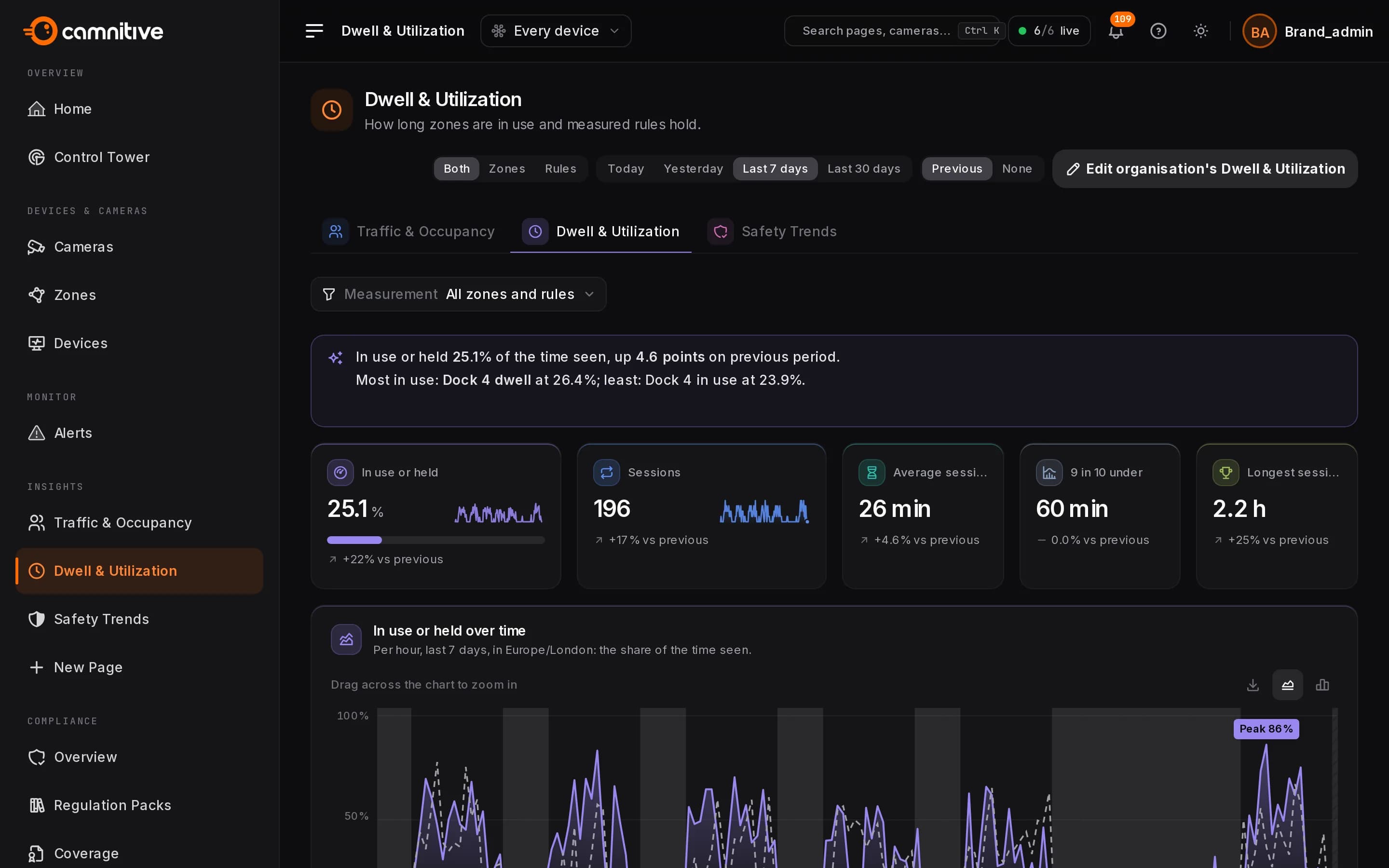
What FloFusion measures for Ports, per zone, per site and over time.
Dock and bay use
How long each dock is occupied, by shift, against the slots you booked.
Dwell at bays
How long trucks, pallets and people stay, and which bays run over.
Near misses per 100 hours
People and forklifts too close, per hour watched, trending week on week.
What a pilot sets out to move
- fewer quay and yard proximity events
- 40–60%
- typical pilot target
- faster gate turn times
- 15–25%
- from continuous queue analytics
- to compile ISPS evidence
- Hours
- sealed records aligned to port security duties
Pilot targets agreed with you up front, not past results.
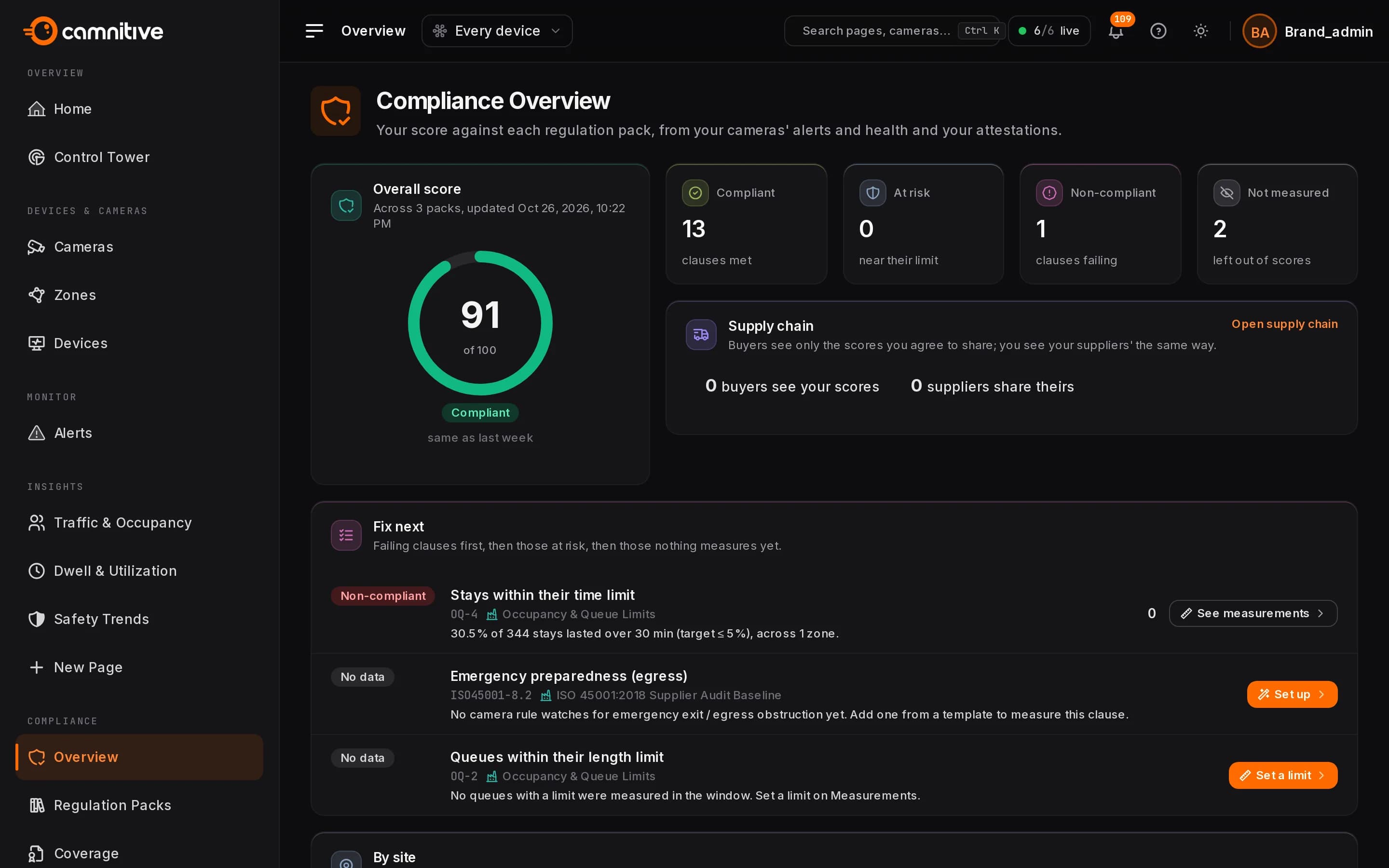
Comply · Step 3 of 4
Proof that holds up with auditors.
The rules that apply to Ports, scored continuously from camera evidence, with a signed record anyone can verify.
EU AI Act
AI used for workplace monitoring and safety is high-risk: you must run risk management, keep event logs, maintain technical documentation, and guarantee human oversight and accuracy monitoring.
NIS2 Directive
Essential and important entities must secure their network and information systems (including OT and camera networks), with incident reporting duties.
UK GDPR and Data Protection Act 2018
Video of identifiable people is personal data: you need a lawful basis, transparency, data minimisation and retention limits, and a DPIA before systematic monitoring of staff.
ICO guidance on monitoring workers
Monitoring must be necessary, proportionate and open: tell workers what you monitor and why, consult them, choose the least intrusive means, and avoid covert monitoring.
Improve · Step 4 of 4
What to change next.
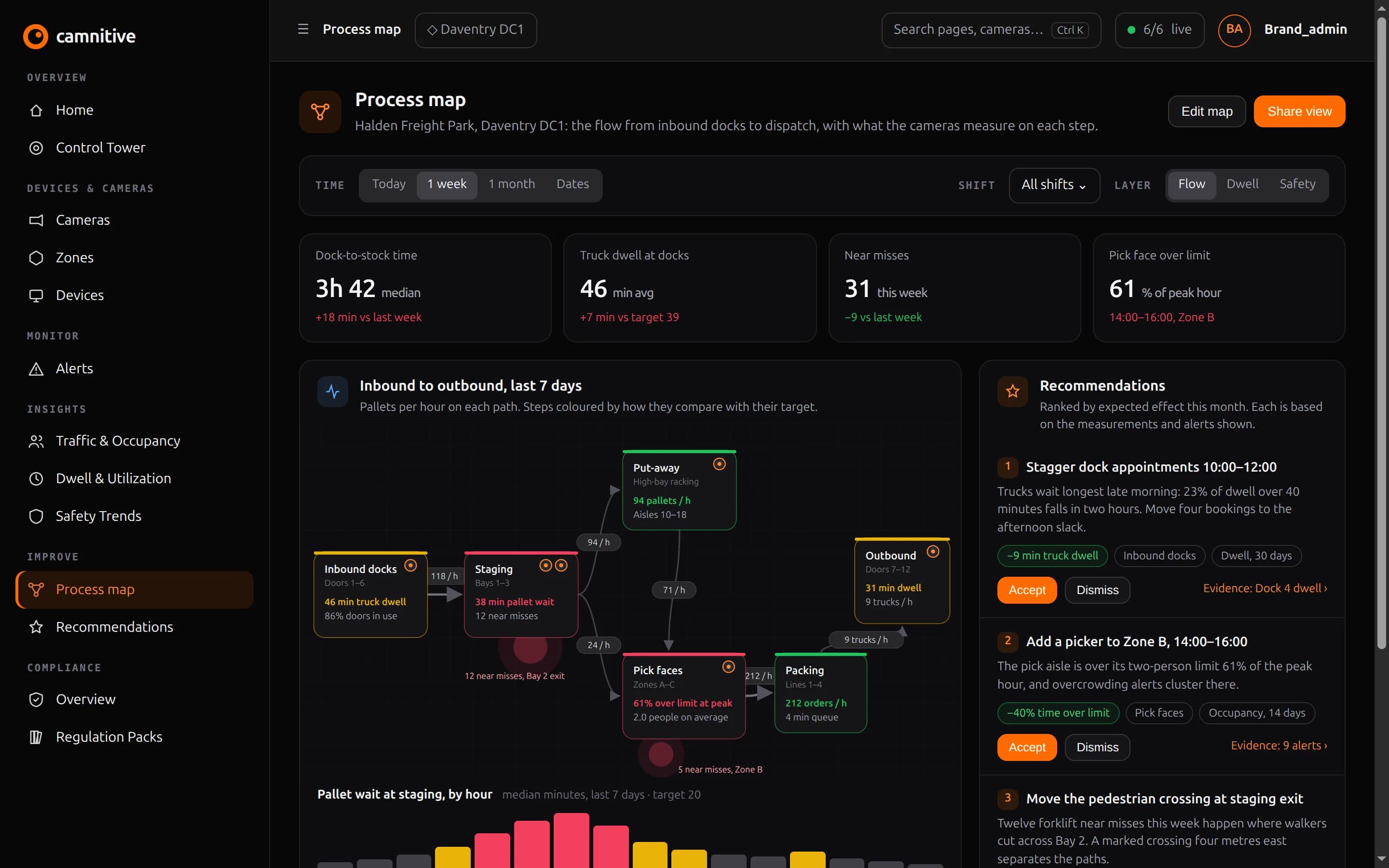
The process map shows where the floor loses time and where people and vehicles meet.
Re-time the dock slots
Spread arrivals off the peak the map shows, so bays stop queuing at shift change.
Separate the pedestrian route at bay 2
Move the walkway away from the forklift lane where near misses cluster.
Examples of what a pilot’s process map points to.
Getting started
A pilot on the cameras you own.
Prove quay and yard proximity, restricted berth zones, and gate analytics at one terminal, inside your port estate, on the cameras already watching it, with ISPS-aligned evidence.
Scope
- Quay cranes and yard equipment corridors (person–equipment proximity)
- Active berths and mooring operations (exclusion enforcement)
- Gates and queue lanes (truck turn time, gate flow)
- ISPS perimeter and restricted areas (intrusion with evidence)
We configure
- Plain-English proximity and berth-zone rules tied to vessel operations and shifts
- FloFrame on-prem inference: video never leaves the port estate
- Escalation paths for terminal control, HSE, and port security
- FloFusion evidence records aligned to ISPS and port-authority reporting
You walk away with
- Faster time-to-awareness for proximity and berth-zone breaches
- Gate turn-time and queue baselines from existing cameras
- Sealed evidence for every safety and security exception in scope
Questions
Ports: common questions.
Can this run inside our port network without video leaving the estate?
Yes, that is the default. FloFrame processes video inside the estate; only alerts and sealed evidence go to FloFusion, over outbound HTTPS. FloFusion is hosted by Camnitive, or deployed privately in your own cloud or data centre.
Link to this questionDo night, rain or glare at the terminal break detection?
The detections are built for outdoor industrial CCTV. During the pilot we tune zones, thresholds and cooldowns against your real lighting, weather and container shadows before scaling.
Link to this questionHow does this fit our ISPS security obligations?
Perimeter, restricted-area and access events are recorded with sealed, time-stamped evidence. That gives ISPS reviews and port-authority reports a continuous record instead of a logbook.
Link to this questionCan the same cameras measure truck turn time and gate flow?
Yes. The cameras that watch safety at the gates also measure queues, turn time and gate flow in Insights.
Link to this questionWhat do terminals typically start with?
Quay and yard proximity, restricted berth zones and PPE at the riskiest points. Then gate flow, container dwell and perimeter security on the same cameras.
Link to this questionHow disruptive is deployment to a 24/7 terminal?
Barely. FloFrame reads existing camera streams, so there is no crane downtime and no new cabling on the quay. Zones and rules change in minutes as operations do.
Link to this questionSee it on your own cameras.
A demo on footage from an operation like yours, then a pilot on the cameras you own.