
Manufacturing & industry
Every shift, by the rules.
PPE, machine zones, line stoppages and hygiene areas, scored against the standards your auditors use.
In manufacturing
What goes wrong today.
Safety depends on who happens to be watching
Supervisors cannot watch every line on every shift. PPE lapses and zone breaches surface only after an incident report is filed.
Audit preparation eats weeks of skilled time
EHS and quality evidence is assembled by hand from scattered footage, spreadsheets, and memory, every single audit cycle.
CCTV records incidents but never prevents them
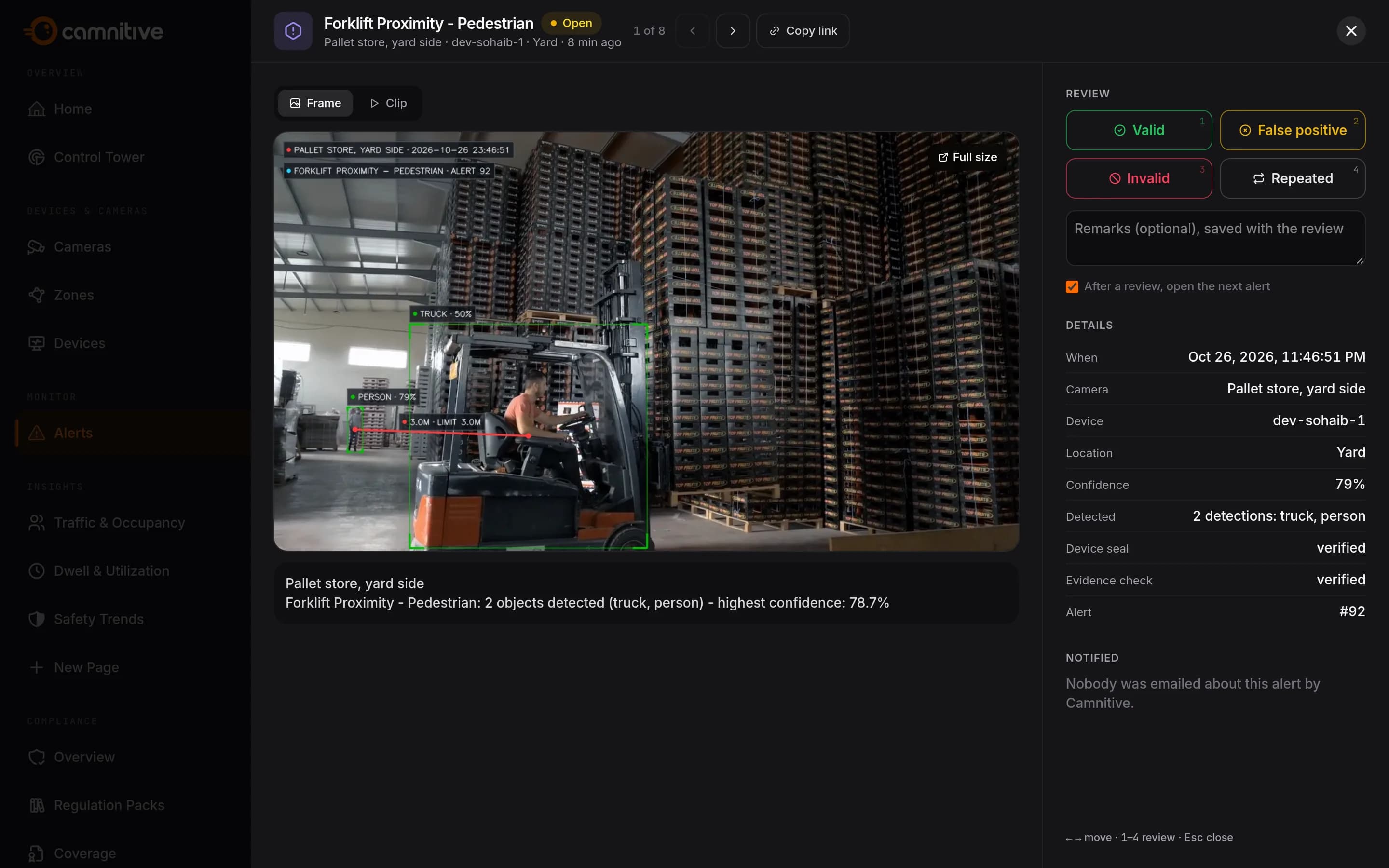
Your cameras see every violation and near-miss. Nobody reviews the footage until something has already gone wrong.
Detect · Step 1 of 4
What the cameras watch for.
FloFrame sits on the plant network beside your VMS: no production VLAN changes and no cloud dependency on the line.
Sealed evidence
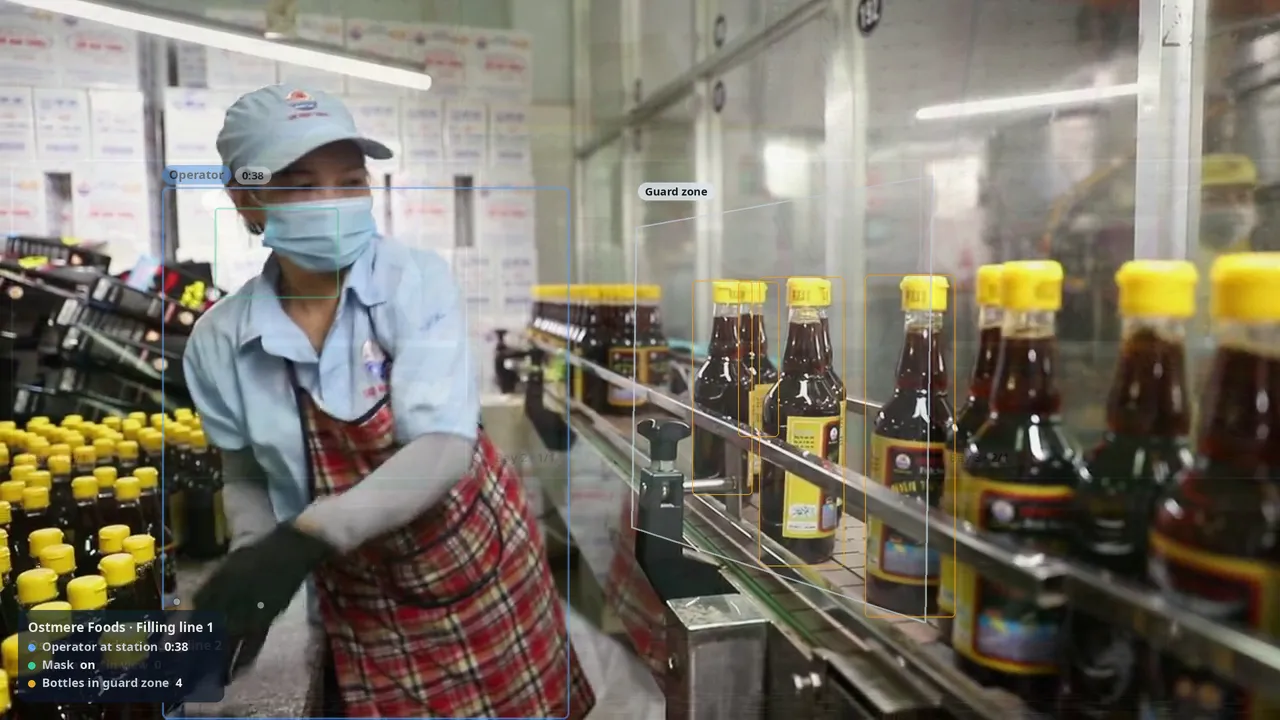
Ostmere Foods Packing Plant
Demo footage, annotated the way FloFrame does. Each card appears as its alert is raised.
PPE compliance
Hard hats, hi-vis vests, gloves, and goggles checked on the plant floor, every shift.
Restricted zones
Instant alerts when people enter machine cells or hazardous areas.
Line stoppage detection
Catch stopped lines and starved stations the moment they happen.
Packaging verification
Visual checks on labeling, palletizing, and end-of-line quality.
Housekeeping & 5S
Automated audits of blocked aisles, spills, and workplace organization.
Compliance scorecards
Audit-grade evidence and trends for EHS and quality teams.
Rules
Rules you would run.
Written in plain words, run on site, checked by a vision model before anyone is alerted.
PPE compliance
“Everyone on the production floor wears a helmet and hi-vis vest during shift hours”
Then: LINE LEAD NOTIFIED · CLIP SEALED ✓
Open in the Rule PlaygroundRestricted zones
“No entry to the robot cell while the line is running”
Then: SUPERVISOR PAGED · CLIP SEALED ✓
Open in the Rule PlaygroundLine stoppage
“Flag any line stopped for more than 4 minutes during a production shift”
Then: OPS DASHBOARD ALERT · TREND LOGGED
Open in the Rule Playground
Measure · Step 2 of 4
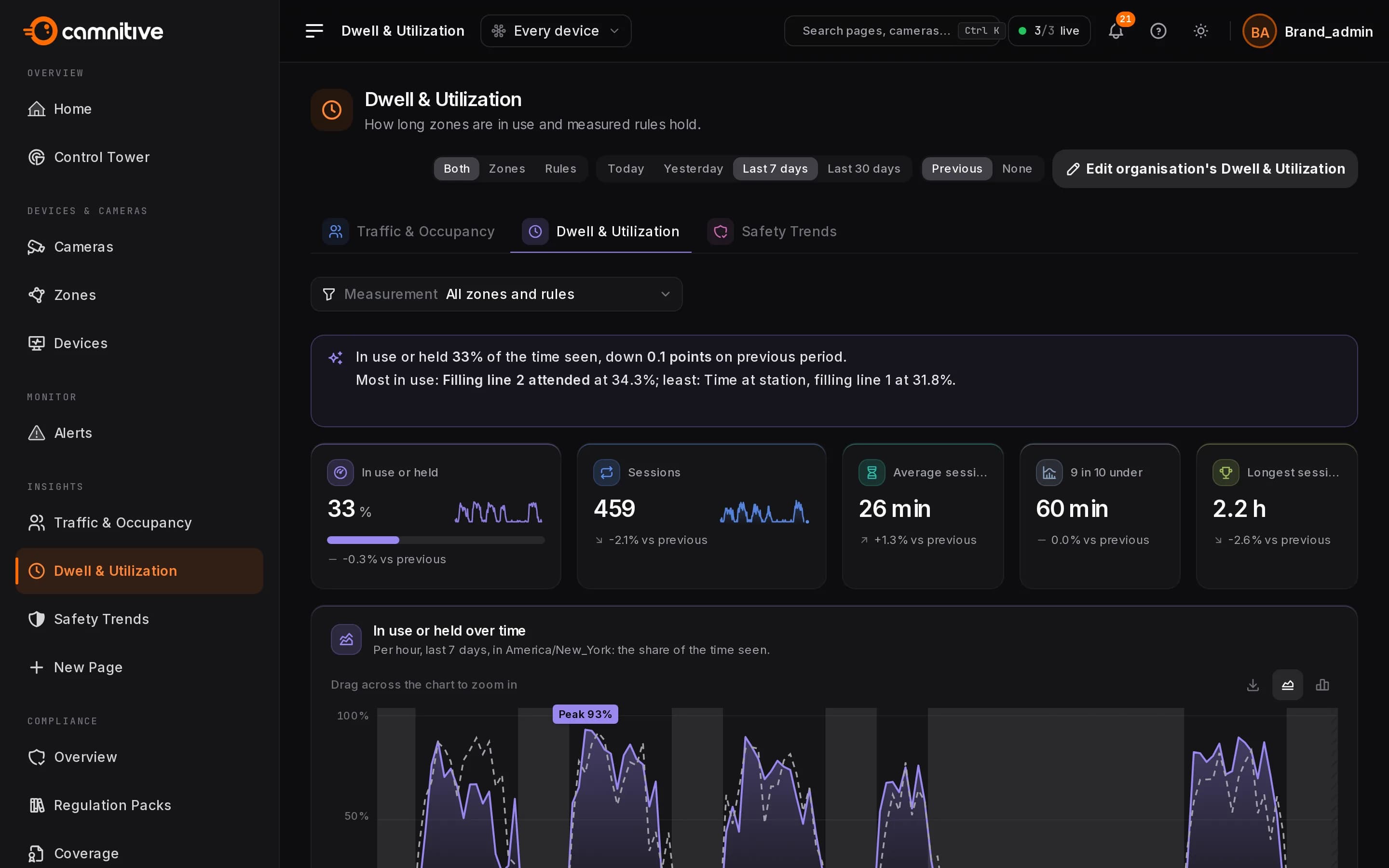
Every alert becomes a number you manage.
What FloFusion measures for Manufacturing, per zone, per site and over time.
Line staffing
People at each station and bay, against the crew the line was planned for.
Time at station
How long operators stay at each station, and where stations sit empty.
Guard-zone near misses
Reaches into guarded zones while the line runs, per hour watched.
What a pilot sets out to move
- fewer PPE and zone violations
- 30–50%
- measured within the pilot window
- less manual footage review
- 80%+
- alerts replace hours of scrubbing
- to produce audit evidence
- Hours
- instead of weeks of preparation
Pilot targets agreed with you up front, not past results.
Comply · Step 3 of 4
Proof that holds up with auditors.
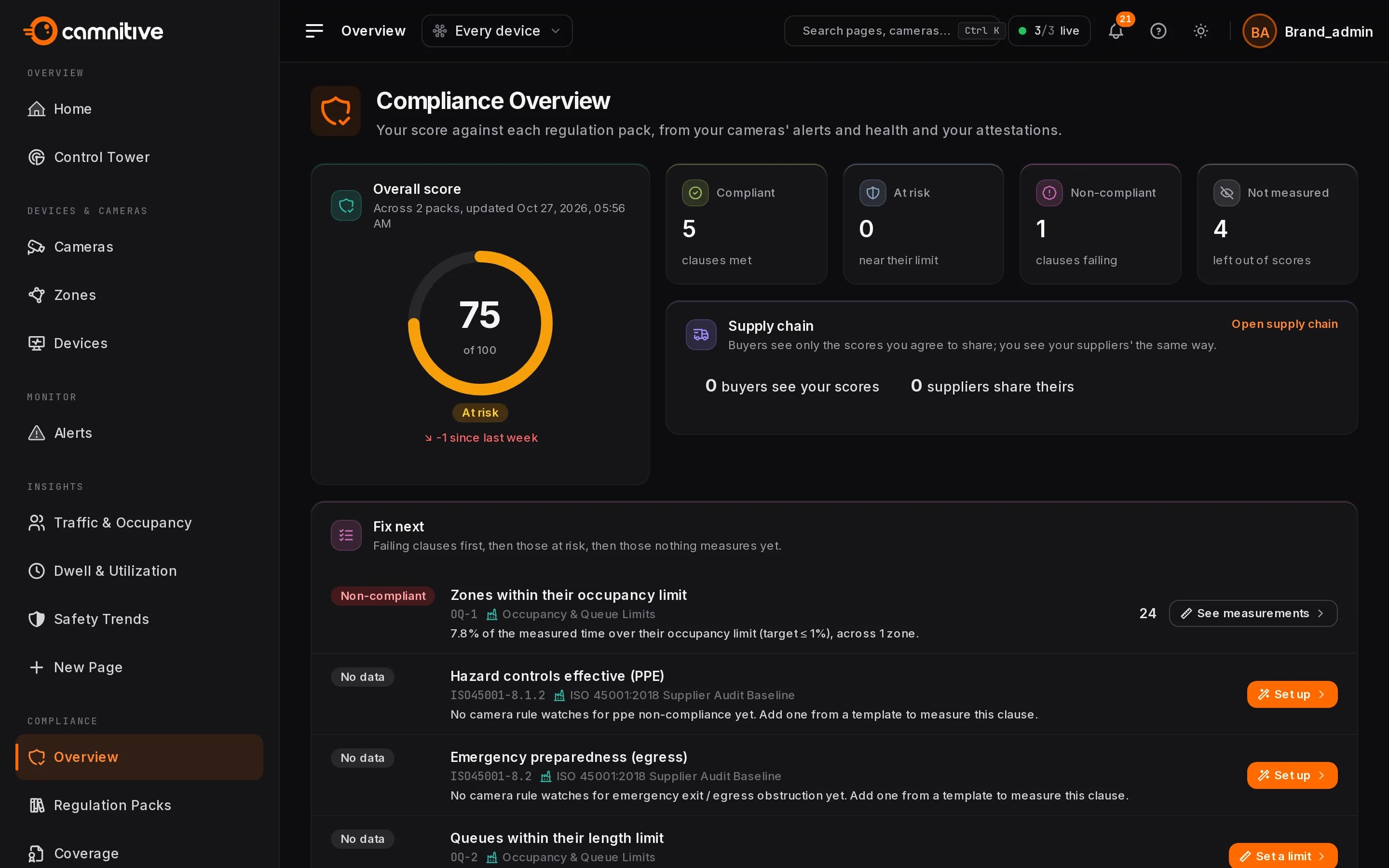
The rules that apply to Manufacturing, scored continuously from camera evidence, with a signed record anyone can verify.
EU AI Act
AI used for workplace monitoring and safety is high-risk: you must run risk management, keep event logs, maintain technical documentation, and guarantee human oversight and accuracy monitoring.
EU OSH Framework Directive
Employers carry a general duty to prevent occupational risks and demonstrate systematic prevention measures.
UK GDPR and Data Protection Act 2018
Video of identifiable people is personal data: you need a lawful basis, transparency, data minimisation and retention limits, and a DPIA before systematic monitoring of staff.
ICO guidance on monitoring workers
Monitoring must be necessary, proportionate and open: tell workers what you monitor and why, consult them, choose the least intrusive means, and avoid covert monitoring.
Improve · Step 4 of 4
What to change next.
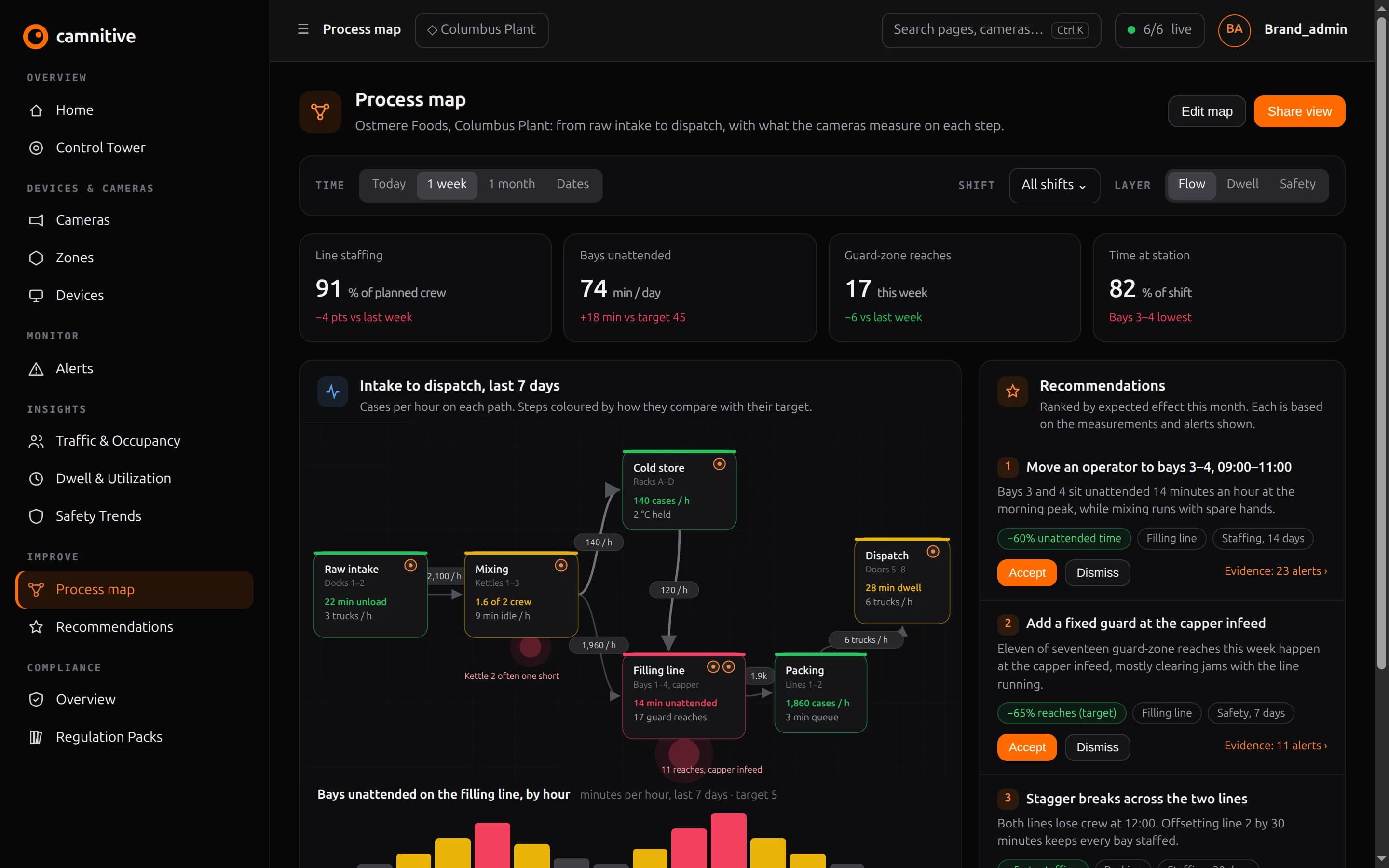
The process map shows where the line is short of hands and where people reach into moving parts.
Rebalance bays across shifts
Move an operator to the bays the map shows unattended at peak.
Guard the capper infeed
Add a fixed guard where reaches into the bottle stream repeat.
Examples of what a pilot’s process map points to.
Getting started
A pilot on the cameras you own.
Deployed in days, not weeks: validate alert quality, compliance evidence, and operational workflows in one facility, with zero training data and no per-site model tuning.
Scope
- High-impact production lines (PPE, line stoppage, packaging verification)
- Staging, WIP, and receiving zones (housekeeping/5S, inventory movement)
- Restricted and hazard areas (zone violations with evidence)
- Entrances or perimeter (after-hours exceptions)
We configure
- Plain-English rules per zone, shift schedules, thresholds, and cooldowns
- Severity tiers (informational vs urgent)
- Alert routing (ops/quality/EHS) and acknowledgment workflow
- Baseline compliance reporting (exceptions by zone and shift)
You walk away with
- Alert precision and volume within agreed thresholds
- Time-to-acknowledge improvement vs baseline
- Audit-ready evidence trail for every safety and quality exception
- Identified hotspot zones and repeat exception patterns
Questions
Manufacturing: common questions.
Do we need new cameras or a new VMS?
No. Camnitive works with the RTSP and ONVIF cameras you already own and runs alongside your current VMS or NVR. Each site adds one FloFrame box: an x86 server with an NVIDIA GPU.
Link to this questionHow long does deployment take, and do we need to train models?
A pilot of 10–50 cameras usually goes live in days. People, vehicles, PPE, line stoppages, fire and smoke are standard detections, so there is no training data to collect. You set the rules, and they run from day one.
Link to this questionCan we monitor different lines or zones with different policies?
Yes. Rules are set per camera and per zone, with their own thresholds, cooldowns and shift schedules. PPE, restricted-zone and packaging rules can differ by line.
Link to this questionHow do we reduce false alarms on busy production floors?
Zones, schedules and minimum durations decide what fires. A vision-language model then checks each alert, and your team marks it valid, false positive, invalid or repeated, so the noise is measured and tuned out.
Link to this questionWhat happens when an auditor or insurer asks us to prove compliance?
Every alert is sealed on the device and verified when it reaches FloFusion. Regulation packs score your clauses continuously, and each score is a signed, hash-chained snapshot anyone can verify. You share a link to the record instead of a binder.
Link to this questionCan we run in environments with strict IT/OT and data-residency controls?
Yes. Video is processed on site and stays there. FloFrame only connects out, over HTTPS on port 443, so no inbound ports or VPN are needed. FloFusion is hosted by Camnitive, or deployed privately in your own cloud or data centre.
Link to this questionWhat do teams typically start with first?
Detect PPE, restricted-zone entries and line stoppages on a few lines. Then measure stoppage time and repeat zones in Insights, score them in a pack such as ISO 45001, and use the trends to decide what to fix next.
Link to this questionHow does this change our incident rates and insurance conversations?
You bring measured trends and sealed evidence to insurer reviews and audits, instead of self-reported checklists. Lower incident rates are a pilot target, set with you before it starts.
Link to this questionCan an alert trigger something on the line?
Yes. FloFrame drives outputs on site: HTTP relays, Modbus TCP, ONVIF relays and MQTT, for a beacon, a horn or a PLC signal. It is an aid next to your certified safety systems, never a replacement.
Link to this questionSee it on your own cameras.
A demo on footage from an operation like yours, then a pilot on the cameras you own.