
Transport & public spaces
Crowds you can see coming.
Density, queues, platform edges and egress, live and over time, across every station, terminal and venue.
In transportation
What goes wrong today.
Depots concentrate risk at shift change
Reversing vehicles, tired drivers, and pedestrians converge twice a day, and every conflict is invisible until it is a claim.
Claims are decided by whoever has evidence
Disputes over yard incidents, cargo damage, and gate events settle against you when the footage is gone.
Dwell time leaks money at every bay
Load and unload durations are guessed, not measured. Slow bays and repeat offenders hide in the average.
Detect · Step 1 of 4
What the cameras watch for.
Depot, yard, and gate cameras converge on one platform. FloFleet extends the same coverage into the cab.
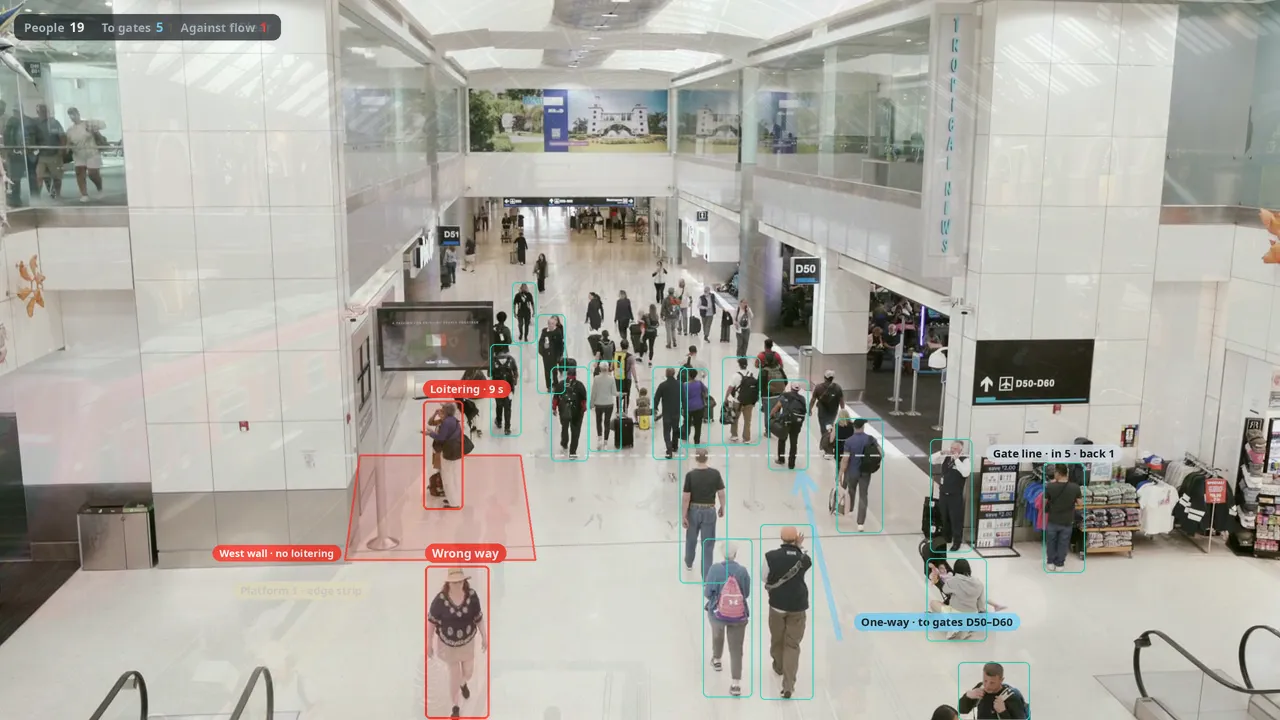
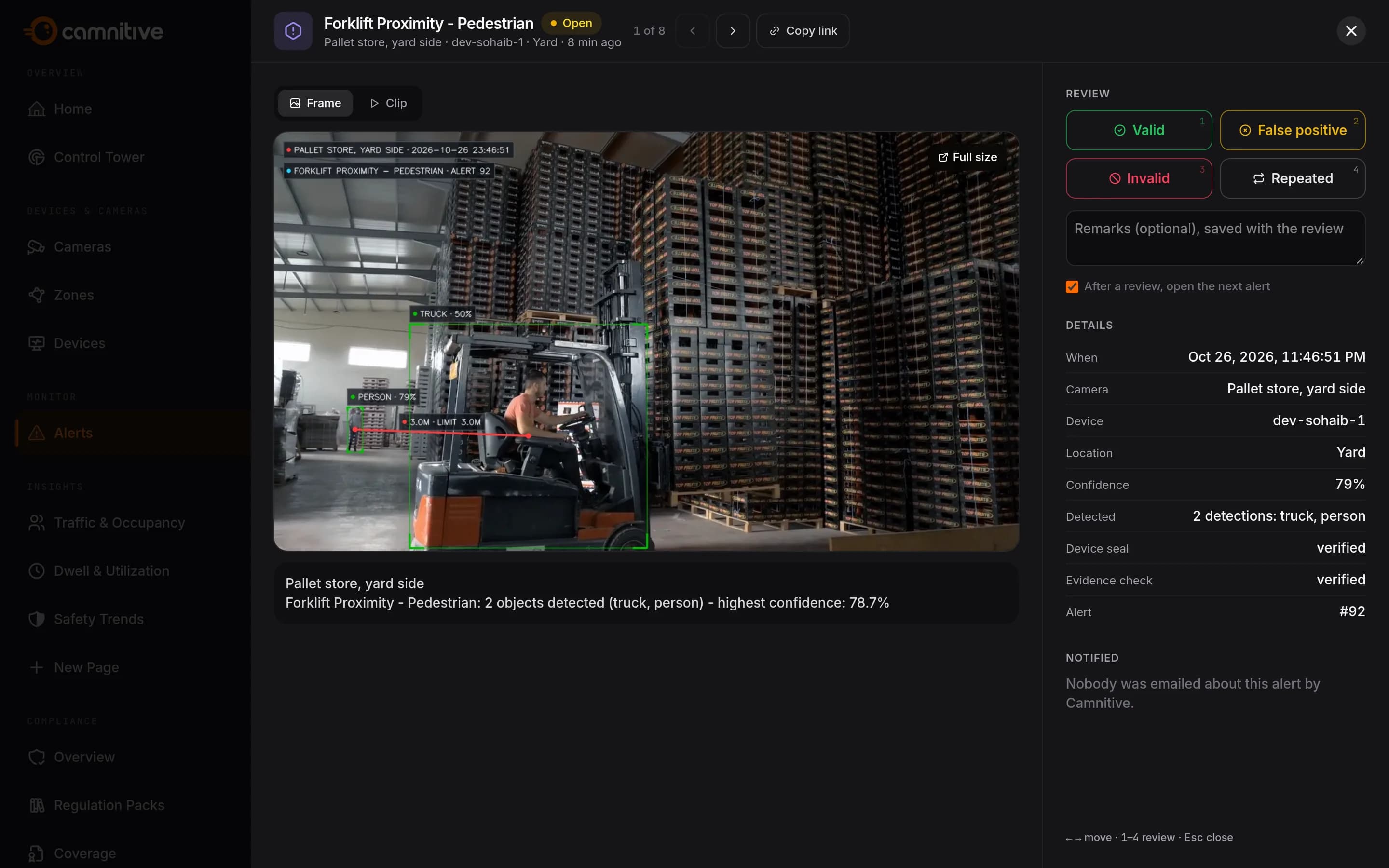
Sealed evidence
Metrovale Central
Demo footage, annotated the way FloFrame does. Each card appears as its alert is raised.
Depot safety & near-miss
Vehicle–person conflicts caught and trended.
Load/unload dwell time
Duration analytics on every bay.
Gate & yard security
Access events with evidence attached.
Incident evidence capture
Sealed clips for every claim and dispute.
Pedestrian walkways
Walkway discipline enforced continuously.
FloFleet fleet safety
Driver behavior and fatigue on the same platform.
Rules
Rules you would run.
Written in plain words, run on site, checked by a vision model before anyone is alerted.
Reversing safety
“No one behind a reversing truck anywhere in the yard”
Then: DRIVER + YARD PAGED · CLIP SEALED ✓
Open in the Rule PlaygroundWalkway discipline
“Pedestrians on marked walkways only across the depot”
Then: DEPOT LEAD NOTIFIED · TREND LOGGED
Open in the Rule PlaygroundGate logging
“Log every vehicle at the gate with arrival, plate, and dwell”
Then: ACCESS LOGGED · EVIDENCE SEALED ✓
Open in the Rule Playground
Measure · Step 2 of 4
Every alert becomes a number you manage.
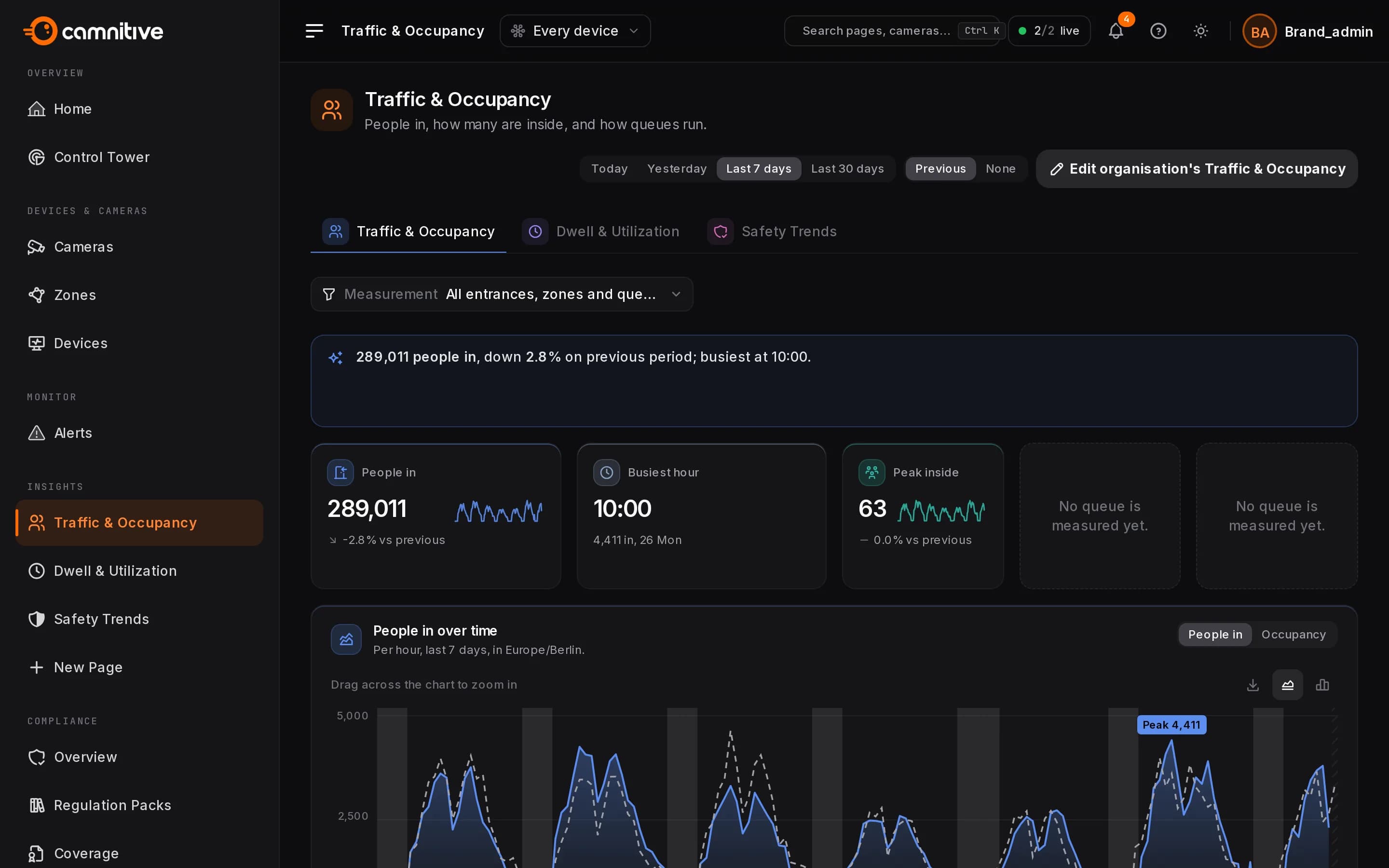
What FloFusion measures for Transportation, per zone, per site and over time.
Platform-edge dwell
Time people stand on the edge strip, highest as trains arrive.
Concourse density
People per zone against its limit, minute by minute.
Gate throughput
People through each gate line, in and out, by hour.
What a pilot sets out to move
- fewer walkway violations
- 30–50%
- typical pilot target across the depot
- to pull claims-ready evidence
- Minutes
- sealed clips with chain of custody
- measured for dwell
- Every bay
- continuous, camera-based duration analytics
Pilot targets agreed with you up front, not past results.
Comply · Step 3 of 4
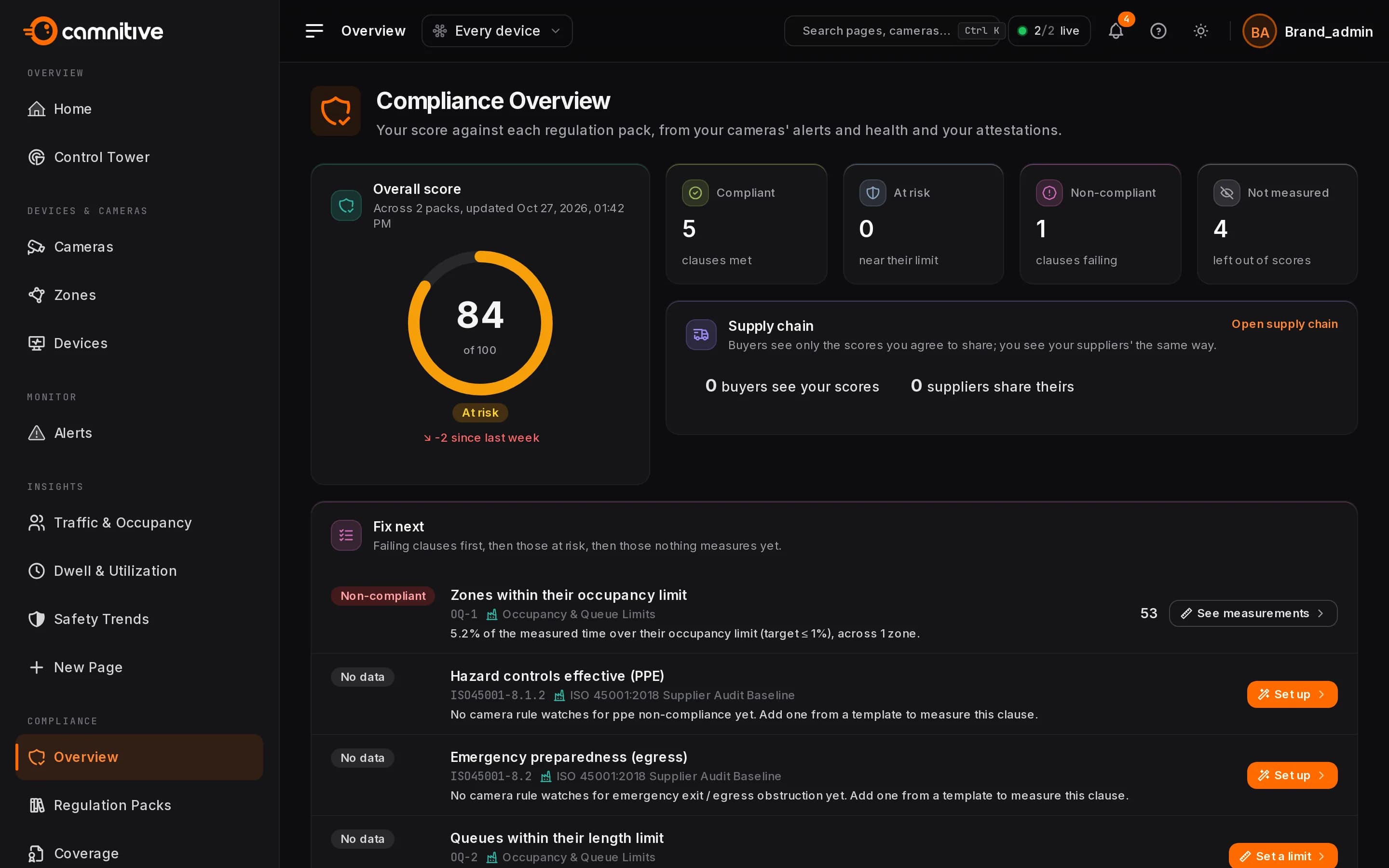
Proof that holds up with auditors.
The rules that apply to Transportation, scored continuously from camera evidence, with a signed record anyone can verify.
EU AI Act
AI used for workplace monitoring and safety is high-risk: you must run risk management, keep event logs, maintain technical documentation, and guarantee human oversight and accuracy monitoring.
NIS2 Directive
Essential and important entities must secure their network and information systems (including OT and camera networks), with incident reporting duties.
UK GDPR and Data Protection Act 2018
Video of identifiable people is personal data: you need a lawful basis, transparency, data minimisation and retention limits, and a DPIA before systematic monitoring of staff.
ICO guidance on monitoring workers
Monitoring must be necessary, proportionate and open: tell workers what you monitor and why, consult them, choose the least intrusive means, and avoid covert monitoring.
Improve · Step 4 of 4
What to change next.
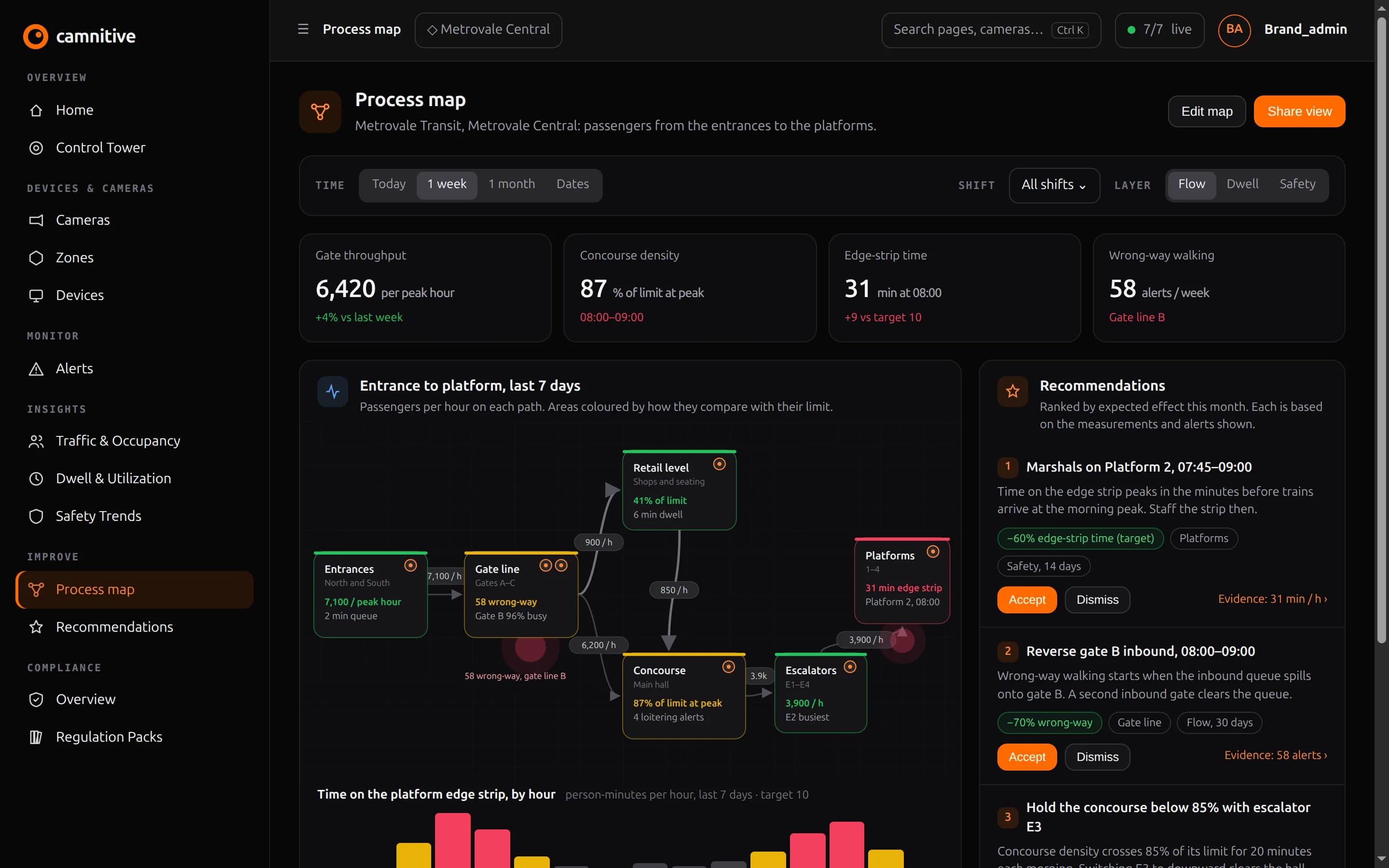
The process map shows where crowds build and how people move against the flow.
Marshals on the platform at peak
Staff the edge strip in the minutes before trains, when dwell peaks.
Reverse a gate at the morning peak
Open a second inbound gate between 08:00 and 09:00, where wrong-way walking starts.
Examples of what a pilot’s process map points to.
Getting started
A pilot on the cameras you own.
Deployed in days, not weeks: prove collision/near-miss visibility, driver behavior monitoring, and load/unload tracking in controlled zones, with zero training data and no per-site model tuning.
Scope
- Gate/entry and dispatch lanes (truck queues, vehicle counting)
- Yard areas with crossings or conflict points (collision alerts, yard occupancy)
- Loading docks and bays (load/unload duration)
- Parking and after-hours zones (intrusion and anomalies)
We configure
- Plain-English safety and behavior rules per zone
- Conflict-point ROIs (crossings, lane boundaries) and time-in-zone thresholds
- Severity and escalation paths (safety vs operations)
- Shift-aware schedules (peak vs after-hours)
You walk away with
- Reduction in nuisance alerts after tuning
- Improved time-to-awareness for safety exceptions
- Evidence-backed reporting by site, zone, and time window for coaching and operations
- A roadmap for what's next: FloFleet fleet analytics and insurance/safety scoring
Questions
Transportation: common questions.
Is this for fleet (in-vehicle) cameras, fixed cameras, or both?
Most customers start with the fixed cameras they already own at depots, yards and gates. In-cab driver safety comes with FloFleet.
Link to this questionHow long does deployment take, and do we need to train models?
A pilot of 10–50 cameras usually goes live in days. People, vehicles and PPE are standard detections, so there is no training data to collect.
Link to this questionCan rules be different by site, route, or shift?
Yes. Rules are set per site, zone and schedule, so gate, yard and dock rules can differ by location and between peak and after-hours.
Link to this questionHow do we avoid noisy alerts in high-traffic areas?
Zones, minimum durations and cooldowns decide what fires. A vision-language model checks each alert, and your team marks it valid, false positive, invalid or repeated.
Link to this questionWhat does an alert actually contain?
Time, camera, the rule that fired, the clip and the model check with its reason. It is sealed on the device and verified on arrival, so it holds up when someone asks for proof.
Link to this questionCan it warn of collisions in real time?
FloFrame detects on site, so alerts at crossings and conflict points arrive within seconds and can drive a light or horn on site. What it can catch depends on camera placement, and it is an aid next to certified safety systems.
Link to this questionWhere does our video and data live?
On site. FloFrame processes video where it is recorded; only alerts, chosen evidence and measurements leave. FloFusion is hosted by Camnitive, or deployed privately in your own cloud or data centre.
Link to this questionCan the same cameras measure loading, dwell, and turnaround times?
Yes. The cameras that run safety rules at docks, gates and yards also measure dwell and turnaround, so the same deployment pays back in throughput.
Link to this questionSee it on your own cameras.
A demo on footage from an operation like yours, then a pilot on the cameras you own.