
Use case · Compliance
Housekeeping & 5S monitoring
The monthly 5S walkaround samples an hour of your operation. Your cameras see all seven hundred.
The problem
Why it keeps happening.
Housekeeping standards decay between audits: blocked aisles, staged pallets in walkways, spills waiting for someone to report them. The audit itself measures a snapshot that everyone tidied up for.
Blocked egress routes are more than a score: they are a life-safety violation and a standard citation during inspections.
The rule
Written the way you'd say it.
“Flag aisles or emergency exits blocked for more than two minutes.”Compile it in the Rule Playground
How it runs
- 01
Define what "clear" means per area
Aisles, egress routes, laydown areas, and 5S zones are marked on existing camera views with per-area standards.
- 02
Flag violations as they form
A pallet dropped in a walkway, an exit blocked, or a spill on the floor is flagged within minutes, with the threshold your policy sets, not a person walking by.
- 03
Notify the owner, not a queue
Alerts route to the area owner on shift. Repeat or ignored conditions escalate.
- 04
Score continuously
Per-area, per-shift compliance trends replace the audit snapshot, with sealed evidence behind every data point.
Measure
What's measured.
- Minutes each aisle or exit stayed blocked
- Conditions per area and shift
- Time from alert to correction
What it’s worth
- Egress violations corrected in minutes, not found by inspectors
- Slip, trip, and collision hazards removed faster
- Audit preparation reduced to exporting live scores
- A floor that stays at standard between audits
Estimate your ROI for your own operation, in about two minutes.
Comply
The evidence.
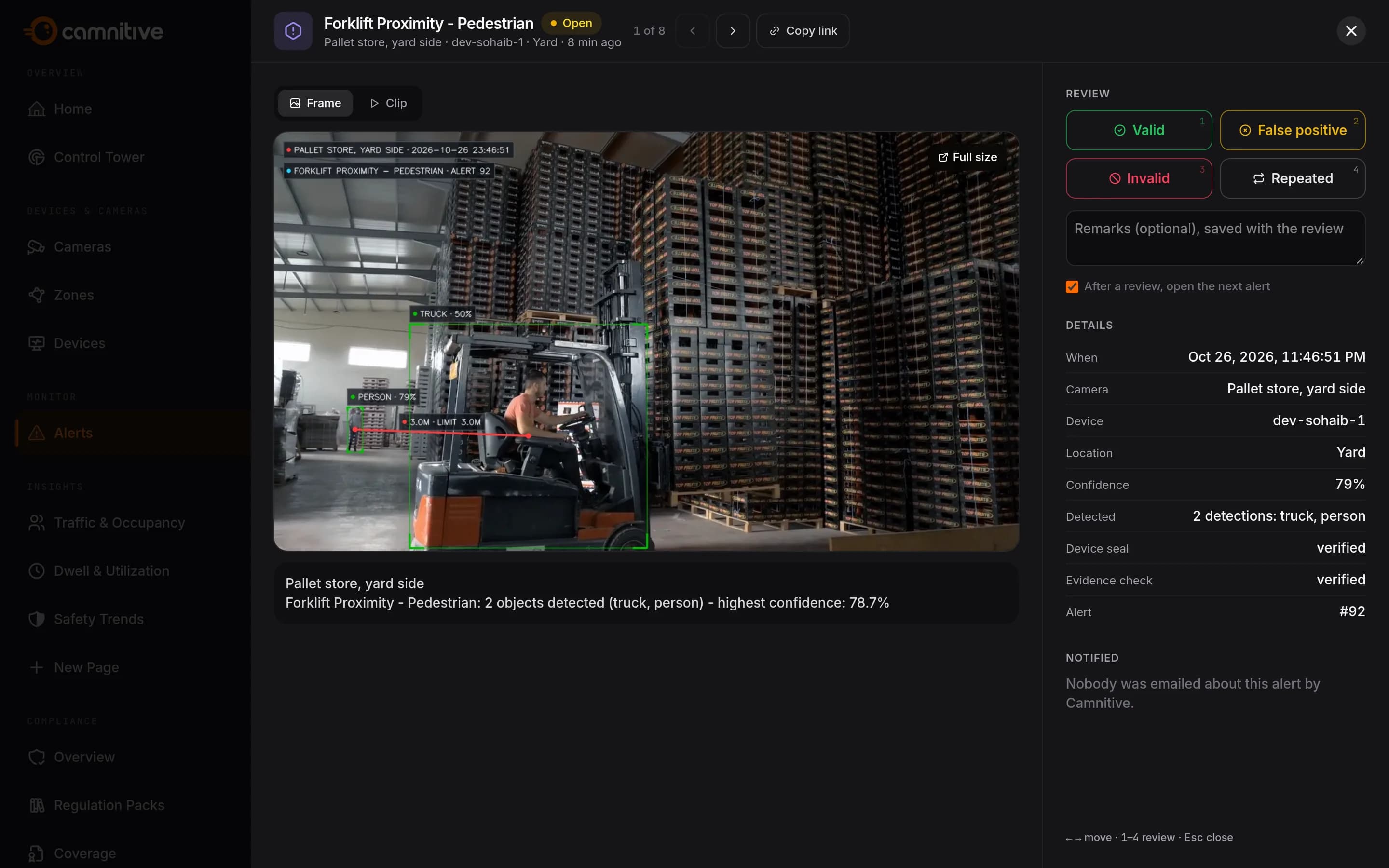
- A clip and frame of the event, sealed with the device’s own key the moment it happens
- The rule that fired, the zone and camera, and the time
- The vision-language model’s verdict on the alert, with its reason
- Who saw it, who acted, and when, in the audit log
Where it applies
Related industries.
Common questions
How is this different from doing 5S audits with tablets?
Tablets speed up sampling, but the samples stay sparse. Cameras measure every hour of every shift and catch a condition when it appears.
Link to this questionCan standards differ by area?
Yes. Rules are per camera and per zone, so a dock, a production cell and a cleanroom corridor each keep their own standard.
Link to this questionMore use cases
The use-case libraryCompliance
Gowning & hygiene compliance
Every cleanroom entry, every shift, verified, with the sealed evidence GMP inspections ask for.
Compliance
Blocked exit detection
A blocked fire exit is invisible right up until the inspection, or the evacuation.
Safety
Forklift–pedestrian detection
The highest-severity risk in most warehouses and plants, watched continuously by the cameras already on the ceiling.
See it on your own cameras.
A pilot on the cameras you already own, with success criteria agreed up front.