
Industrial enterprises have spent decades installing CCTV across factories, warehouses, yards, construction sites, retail networks, and energy assets, and video surveillance is now a market of an estimated $73.8 billion a year (Grand View Research, for 2024). The result is the most underused sensor network in industry: in a typical estate, most recorded video is never watched at all, and almost none of it is analyzed as it happens. Cameras see everything and report almost none of it.
A multi-site operation runs hundreds to thousands of cameras. Human supervision can meaningfully watch a handful at a time, with accuracy that decays by the minute. So the richest sensor most sites possess ends up doing one job: providing footage for the investigation after something has already gone wrong.
What the gap looks like on site
- Cameras record, not prevent. Footage is reviewed after an incident. The real-time value of the asset is forfeited.
- Manual audits don't scale. Safety walks and quality rounds sample reality, subject to fatigue, shift gaps, and inconsistency.
- Incidents surface too late. Injuries, shrinkage, and process drift are discovered when the cost is already booked.
- No defensible evidence trail. When a regulator, insurer, or brand auditor says “prove it,” footage silos and paper checklists are not an answer.
The cost is not hypothetical
The International Labour Organization estimates work-related injuries and illnesses cost roughly 4% of global GDP every year. Late discovery is a direct driver: it converts near-misses into recordable injuries, shrinkage into write-offs, and process drift into customer complaints. And since 2026 a third cost sits alongside the first two: the inability to prove control. Failed brand audits cost contracts; weak evidence weakens legal and insurance positions; the EU AI Act and data-protection laws such as the GDPR attach real fines to ungoverned monitoring.
The math has flipped
What changed is the economics of closing the gap. Watching every feed with human operators is economically impossible: 24/7 coverage costs an order of magnitude more than machine monitoring, per camera. FloFrame on the cameras you already own runs at a per-camera subscription that fits inside an operations budget, watches every feed on every shift simultaneously, and generates the evidence trail the other approaches cannot.
Because the cameras are already installed, activating them is an operating decision, not a capital project. No rip-and-replace, no new cabling, no camera procurement cycle.
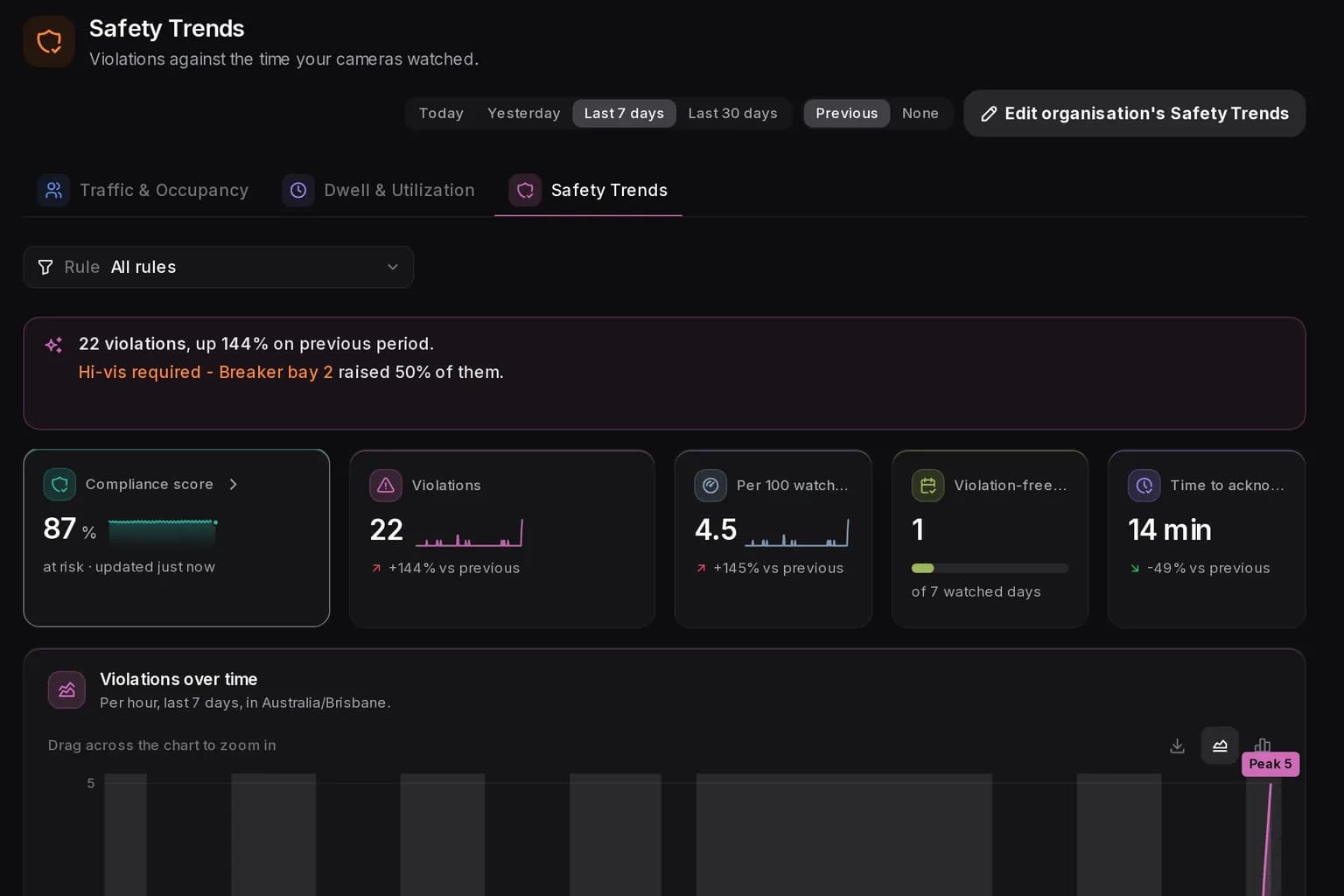
In one multi-country F&B deployment, PPE compliance rose from an audited baseline of roughly 63% to a continuously measured 94% within 90 days, driven not by more policing but by consistent, immediate, evidence-backed follow-up. Violations that once surfaced a day later, if at all, became explained and assigned incidents in under 30 seconds, and manual review hours fell by roughly two-thirds.
Where to start
The proven pattern is deliberately small: 10–50 existing cameras, one or two use cases with clear urgency (PPE and restricted zones are the usual wedge), and a quarter to prove the numbers. From there, expansion stops being a procurement discussion and becomes an operational demand, because site leadership can see violation trends bending downward week over week.
You can model what the gap costs in your own operation (cameras, sites, incident rates, review hours) in about two minutes with our ROI calculator, and turn the result into a scoped pilot plan without talking to anyone first.